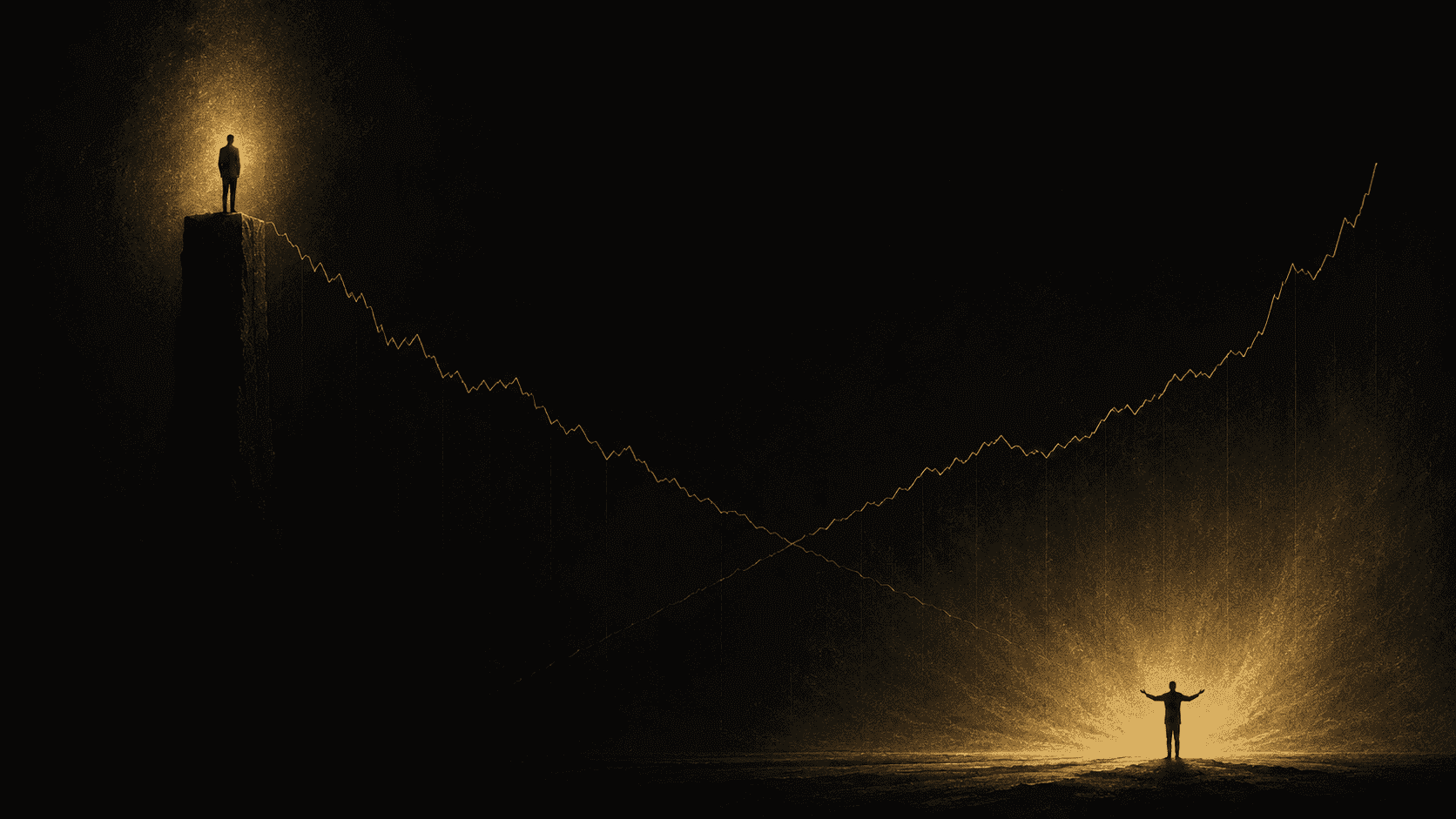
The Sinner’s Dividend
An immune system is not built in clean air but in dirt; the child whose parents scrub his world spotless grows up with defenses that have never been tested, so the first real infection, the one a grubbier child would shrug off in a day, is the one that can crash him. The saint's reputation is that overprotected child. It has met no pathogen and made no antibodies, so the scandal a sinner's name would metabolize without a fever can put the saint in the ground. The sinner has been sick before. His reputation has seen the worst the body can do and lived, and that is not weakness recovered from but immunity earned.
There is a man in Uganda I cannot read.
His name is Muhoozi Kainerugaba. He is the son of the sitting president, the Chief of Defence Forces, and, judging by his X account, either the most reckless first son this country has produced or the most underestimated political mind in the room. I genuinely don't know which. He tweets the way a man tweets when he has decided that decorum is a tax he refuses to pay. He picks fights with foreign leaders. He muses about invading neighbours. He congratulates himself in ways that, if you were briefing him, you would beg him not to.
The verdicts have already been issued. Half the country has written him off as a clown. The other half, smaller and more interesting, suspects something else is going on.
I sit with the second half, but only as far as a question. Because if he is what most people think he is, then time will sort him the way it sorts everyone like that. But if he is not, if some part of this is calculated, then we are watching one of the oldest tricks in the human playbook executed in real time on a national stage: the deliberate manufacture of low expectations as a kind of psychological collateral, to be cashed in later at a premium no honest candidate could ever earn.
This is not really an essay about him. He is the door. Behind the door is something I have wanted to write about for a long time, which is the strange, deeply unequal way reputation actually works.
1. The Saint Pays More
Notice what happens when a pastor is caught in adultery. The story does not stay at the size of the sin. It expands. It becomes a referendum on the man, on his ministry, on every sermon he ever preached, on whether the church itself is a fraud. A single act, often the same act committed quietly by thousands of other men that same week, becomes the defining fact of his life.
Now notice what happens when a known thief gives money to a beggar. The story does not shrink. It expands too, but in the opposite direction. He becomes generous. He becomes complicated. He becomes a man with a heart, after all. his past is not erased, but it is reframed. He is suddenly more interesting than the accountant down the road who has given to the poor every Sunday for thirty years and whom nobody talks about.
The same act of moral deviation produces opposite reputational effects depending on where the actor stood when they committed it. The saint pays interest. The sinner collects dividends.
This is not fair, but it is not random either. It is the mathematics of expectation. Reputation is not a measure of how good you are. It is a measure of how good you are relative to what was expected of you. The pastor was trading at a high valuation. Any bad news brings him violently back to earth. The thief was trading near zero. Any good news is pure upside. The market does not price the act. It prices the surprise.
We do this without thinking. A doctor losing his temper at a nurse is a scandal. A taxi tout losing his temper at a passenger is Tuesday. A politician telling the truth is a headline. A child telling the truth is unremarkable. The behaviour is identical. Only the baseline has changed.
2. The Cheaper Saint Is Loved More
There is a sharper version of this asymmetry, and it is older than journalism. The reformed sinner is not just forgiven. He is preferred. He is loved more than the man who was never lost.
Jesus told this story twice in parable and a third time in his own dying hours, as if he could not stop returning to it . A father has two sons. One says he will work in the vineyard and does not. The other refuses and then goes anyway. Who did the father's will? The one who refused first. The same parable returns as the prodigal son, where the older brother, the dutiful one, the one who never left, stands outside the celebration asking the question every consistently good person eventually asks: what about me? The father does not deny the asymmetry. He confirms it. This your brother was dead, and is alive again; was lost, and is found. The party is for the returnee. The older brother gets a sentence.
I have always found that moment more unsettling than the prodigal's return. The older brother is not wrong. He has done everything correctly, every day, for years, and on the one night he wants to be seen, the lights are pointed elsewhere.
You can watch this same mathematics in Ugandan politics. Bobi Wine has never hidden where he came from. Drugs, ghetto violence, the kind of biography that, in a country with our church culture, should have permanently disqualified him from public reverence. It did the opposite. The walk out of the pit became the source of his moral weight, and when he speaks for the poor, the country hears not just the message but the man who had no business being its messenger. Clean-record opposition figures have made sharper arguments in better English for longer, and the country did not move. He moved it because his rise was visible, public, and televised. The redemption was the campaign.
And then, as if to remove any doubt that this is a pattern rather than a coincidence, the same logic appears on a hill outside Jerusalem. Two thieves are dying beside Jesus. One mocks. The other, in the final hour of a poorly spent life, turns and asks only to be remembered. The reply is immediate and total. Today you will be with me in paradise. No catechism. No probation. No accounting of the years. A man who arrived at goodness in his last conscious minutes is granted what the consistently devout had been working toward their whole lives. Meanwhile, somewhere in that same generation, a lifelong observant Jew who fumbled at the end did not, by the logic of the system, receive that same promise.
The thief on the cross is the redemption premium pushed to its mathematical limit. The foothill rose so suddenly and so high that it briefly overtook every cliff in the region.
This is not a failure of the gospels. It is a description of how value works. The reformed are loved more because their goodness reads as chosen, not inherited. A lifelong saint's virtue can always be explained away as temperament, upbringing, lack of opportunity to be otherwise. The reformer's virtue cannot. He saw the other road, he walked it, and he came back. His goodness has been tested in a way the steady man's never has, and we instinctively trust the tested thing more.This is also why a stripper who speaks about her mother brings the room to silence in a way a nun never could speaking about the same mother. The words are the same. But one of them is paying with currency she had to mint herself.
3. The Fool Who Is Wise
Here is where the asymmetry stops being a description of how the world reads us and starts becoming something a person can use.
If reputation is priced by surprise, then a low baseline is not a curse. It is an asset. The fool who turns out to be wise plays better than the wise man who is exactly as wise as advertised. The wise man, no matter how brilliant, can only meet expectations. The fool can shatter them.
Sun Tzu wrote, appear weak when you are strong . He meant it militarily, but the line travels well into every domain where humans judge other humans. Underestimation is one of the few resources in life that compounds in silence. While you are being dismissed, you are being granted the most valuable thing a competitor can give you, which is the freedom to move without being watched. As we usually joke about it, the best place to be is “under estimated”.
This is the part of the asymmetry that interests me most, because it inverts everything we are taught about reputation. We are told to guard our reputation, to build it carefully, to never let it slip. But a carefully guarded reputation is a fragile and expensive thing. It is a tower that costs more to defend the higher it gets. The man at the bottom of the tower is not necessarily losing. He may simply be playing a different game, one where every step up registers as a miracle, where the room leans in when he speaks because the room had stopped expecting him to.

There is a biology hiding inside this. An immune system is not built in clean air but in dirt; the child whose parents scrub his world spotless grows up with defenses that have never been tested, so the first real infection, the one a grubbier child would shrug off in a day, is the one that can crash him. The saint's reputation is that overprotected child. It has met no pathogen and made no antibodies, so the scandal a sinner's name would metabolize without a fever can put the saint in the ground. The sinner has been sick before. His reputation has seen the worst the body can do and lived, and that is not weakness recovered from but immunity earned.
I do not think most people who benefit from this are doing it deliberately. The reformed thief is not running a strategy. He has simply discovered, by accident, that he occupies a position the consistent man cannot reach. But some people are doing it deliberately. And the trouble with telling the strategic version apart from the genuine version is that, from the outside, they look identical until the very end.
4. Back to the Door
Which brings me back to the man I cannot read.
If Muhoozi is what most people think he is, the asymmetry I have described is irrelevant to him. He is simply paying the ordinary price of being unserious in a serious job, and the country will pay alongside him until time corrects the position.
But if he is not, if there is something underneath the noise that the noise is designed to hide, then he is running one of the most expensive and dangerous variants of this play. He is spending his current reputation, deliberately, to buy a future one (at discount). He is letting the room write him off so that any later display of competence will not be measured against his father's record or his rank or his lineage, but against the cartoon the room has already drawn of him. And against a cartoon, even ordinary competence looks like genius.
I do not know which one it is. I am not sure anyone outside his own head does. But I have stopped being interested in the verdict, because the verdict is the wrong question. The right question is the one his case forces on the rest of us, which is whether we are reading the people around us by what they have actually done, or by the gap between what we expected and what we got.
Most of us are reading the gap. We just don't know it.
The pastor pays for the gap. The thief is paid by it. The prodigal son walks home into it. The older brother stands outside it asking, reasonably, why he ever bothered.
And somewhere, possibly, a man is tweeting carelessly on purpose, building his gap on purpose, so that when he finally chooses to close it, the closing will sound like thunder.
Or he is just tweeting carelessly.
The asymmetry does not care which.